
How to Choose Home Water Purifiers for Central Asia
Water quality, hardness, TDS, pressure, household usage habits and service conditions vary across Central Asia. This guide helps importers, distributors and private-label buyers evaluate RO and UF options, product formats, replacement filters, maintenance, packaging and OEM requirements before bulk purchasing.
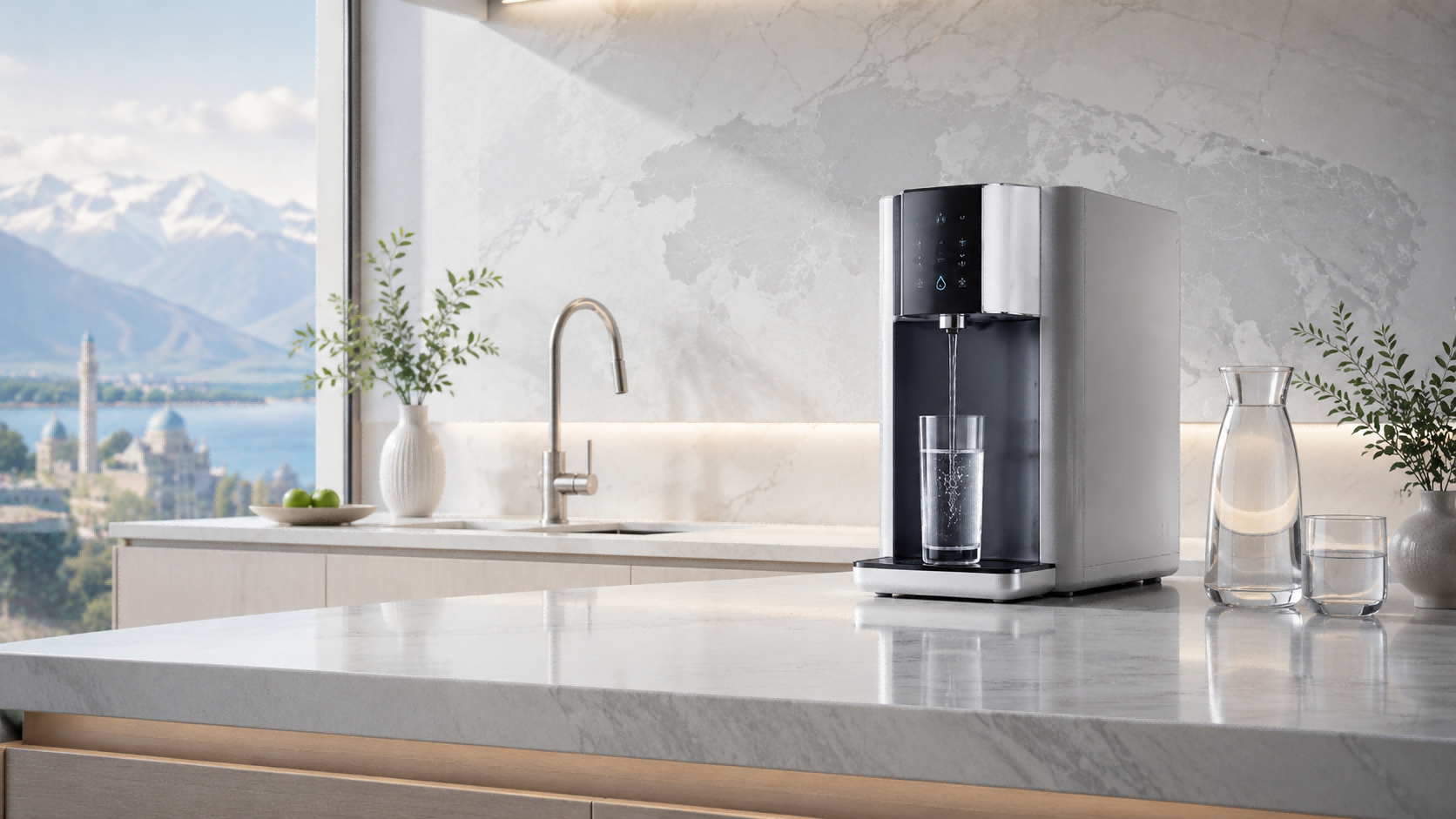
For importers, distributors and private-label buyers serving Central Asian markets, the key question is not simply which water purifier has the lowest unit price. The real task is to build a product portfolio that matches local feed-water conditions, household use, installation realities and after-sales capability.
The same purifier can perform very differently under different TDS levels, hardness, pressure and installation conditions. Before placing a bulk order, buyers should therefore establish a clear technical and commercial checklist.
1. Start with feed-water conditions
Product selection should begin with the water source. Before testing samples, collect information about TDS, hardness, turbidity, sediment, residual chlorine, odor and normal inlet pressure.
RO systems are generally suitable when the goal is to reduce dissolved salts and achieve more consistent drinking-water treatment. Buyers should evaluate not only membrane capacity, but also booster pumps, flushing logic, water-path design and the actual inlet-water conditions in the target market.
UF systems focus more on suspended particles, colloids and part of the microbial load. They should not be treated as a direct replacement for RO when dissolved solids need to be reduced.
2. Match the product format to the household scenario
Under-sink RO purifiers
Under-sink RO systems are well suited to permanent household installation. Check cabinet space, inlet and drain access, faucet installation, machine dimensions, service clearance and pressure requirements.
Countertop and installation-free units
Countertop purifiers are easier to deploy in rental homes, apartments and offices where plumbing modifications are inconvenient. Compare raw-water tank volume, purified-water storage, refill frequency, wastewater handling, footprint and user interface.
Hot, cold and ice-integrated purifiers
Purifiers that combine filtration with heating, cooling or ice-making can support higher-end channels, but require more detailed evaluation of heating power, temperature settings, cooling method, tank capacity, child lock, UV functions, standby consumption and cleaning requirements.
3. Replacement filters matter as much as the machine
The initial equipment sale is only one part of the product lifecycle. For distributors, long-term filter availability has a major impact on customer satisfaction and operating cost.
- Confirm PP, carbon and RO membrane specifications;
- Check whether filters are standard or proprietary quick-change designs;
- Review replacement intervals under different water conditions;
- Confirm MOQ, packaging and lead time for replacement filters;
- Ask whether private-label replacement cartridges are available;
- Make sure matching faucets, tubing, fittings and common spare parts can be supplied continuously.
4. Calculate installation and after-sales cost in advance
A product should not be judged by ex-factory price alone. Installation labor, filters, spare parts, repairs and local service manpower all contribute to the real lifecycle cost.
Before finalizing a model, request installation diagrams, water-path information, replacement procedures and a list of common service parts. For overseas markets far from the factory, easy maintenance can be more valuable than unnecessary feature complexity.
5. Confirm voltage, plugs and labeling before production
Any purifier using pumps, heaters, compressors, UV modules or electronic controls requires advance confirmation of voltage, frequency, plug type, power cable, rating label, manuals, packaging labels and barcode information.
For OEM/ODM orders, logo artwork, color boxes, manuals, labels and shipping marks should be frozen before mass production to avoid costly late-stage changes.
6. Packaging and cross-border logistics are part of product selection
Water purifiers may contain housings, tanks, pumps, displays, faucets and internal tubing. Packaging design directly affects product condition after long-distance transport.
For bulk sourcing, collect carton dimensions, gross weight, net weight, CBM and container-loading quantity. Also inspect internal cushioning, machine fixation, display protection and accessory packing so landed cost can be calculated more accurately.
7. Validate samples before bulk purchasing
A safer sourcing process is: requirement confirmation → model selection → sample testing → configuration approval → packaging approval → mass production.
During sample testing, review actual flow rate, treated-water performance, noise, flushing logic, connector sealing, leak protection, heating/cooling operation, interface usability, filter replacement, packaging protection and multilingual materials.
If possible, test the sample with actual feed water from the target market before freezing the mass-production configuration.
8. Build a product portfolio instead of relying on one model
- Entry level: under-sink RO, UF systems and basic filters;
- Upgrade: high-flow RO, countertop RO and instant-hot purifiers;
- Premium: hot/cold, ice-making and smart-control purifiers;
- Recurring sales: RO membranes, PP filters, carbon filters, faucets, tubing and replacement parts.
9. What information should be included in an RFQ?
Provide the target country, estimated quantity, feed-water conditions, product type, required RO capacity, heating/cooling/ice functions, voltage and plug, OEM branding requirements, packaging language, purchasing schedule and sales channel.
The more complete the information, the faster a supplier can propose an appropriate configuration.
Conclusion
For Central Asian markets, successful home water purifier sourcing depends on more than unit price. Water compatibility, product reliability, replacement-filter supply, easy maintenance, packaging, logistics and after-sales readiness all matter.
Water Tech OEM supports product selection for under-sink RO systems, countertop purifiers, hot/cold and ice-making units, UF systems, replacement filters and components, together with OEM/ODM branding, packaging and bulk-delivery coordination.