
What Parameters Matter When Sourcing Water Purifier Filter Cartridges?
Similar-looking filter cartridges can differ in fit, media construction, micron rating, flow, pressure drop, sealing and batch consistency. This guide outlines what importers and private-label buyers should verify before bulk purchasing replacement filters.
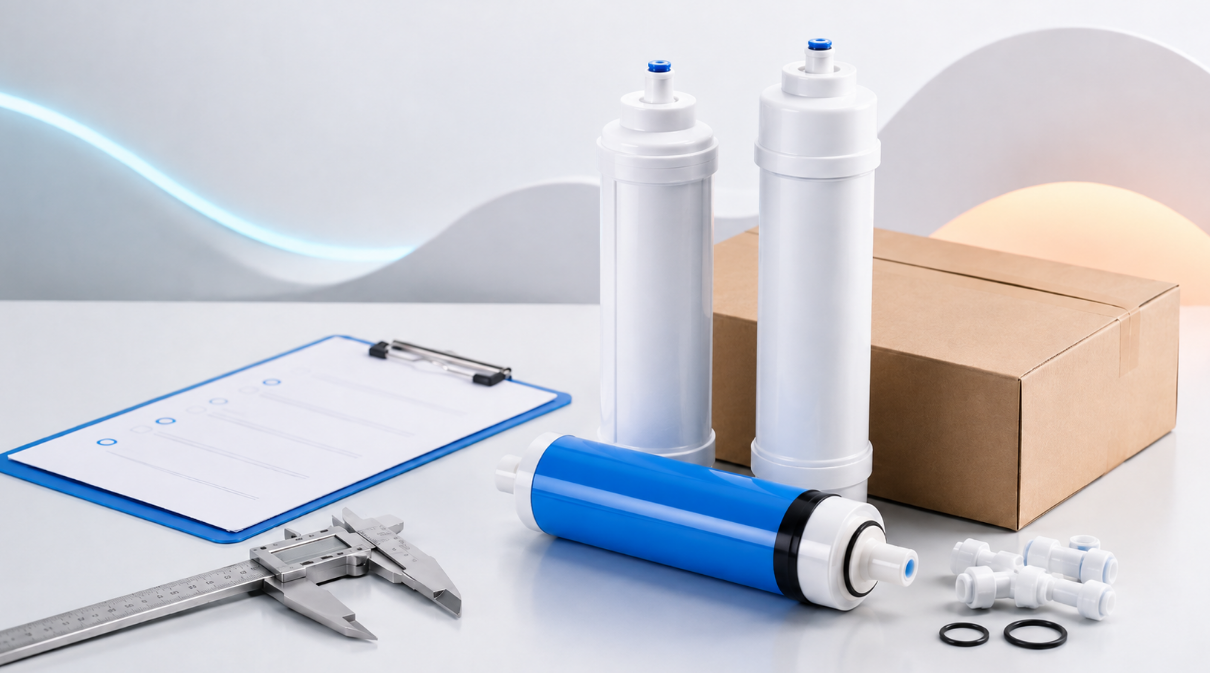
For water purifier importers, distributors and private-label brands, replacement cartridges are not merely accessories. They directly affect user experience, after-sales cost and recurring sales.
Cartridges with very similar appearances can differ in dimensional tolerance, media weight, filtration rating, connector design, pressure drop, flow, sealing and batch consistency. Bulk purchasing therefore requires a specification sheet, approved sample and repeatable incoming-inspection standard rather than a price-only comparison.
1. Confirm exact fit before requesting a quotation
Start with compatibility. Verify overall length, outer and inner diameter, end-cap design, inlet/outlet connection, thread or quick-connect structure, O-ring quantity and position, locking method and compatible housing or purifier model.
For proprietary quick-change cartridges, provide a physical sample, drawing or original cartridge whenever possible. A cartridge may look correct yet fail to lock, seal or route water properly.
2. PP sediment filters are more than a micron rating
For melt-blown PP cartridges, compare media weight, layer density, structural rigidity, dimensional stability, initial pressure drop, rated flow and dirt-holding capacity in addition to nominal micron rating.
Two cartridges marked 5 μm can perform differently if the amount and density distribution of PP material are not the same. Weight and dimension checks are practical incoming-inspection items for bulk orders.
3. Carbon cartridges require material and filling details
Common designs include granular activated carbon, compressed carbon, carbon block and composite carbon structures. Buyers should confirm carbon type, raw material, media weight, filling quantity, block dimensions, density, flow direction and pre/post filtration layers.
Uneven filling or poor internal construction can affect water distribution and treatment performance, so sample teardown or structural confirmation is useful before mass production.
4. RO membranes must be evaluated under real operating conditions
Confirm membrane dimensions, model, nominal capacity, operating pressure, feed-water requirements, temperature, recovery requirements, housing fit and seal specification.
Domestic membranes may be rated at 50G, 75G, 100G, 200G, 400G, 600G or 800G, but the GPD number alone does not determine real output. Temperature, inlet pressure, TDS, hydraulic design and booster-pump performance all influence production rate.
5. Composite cartridges require internal-stage and water-path confirmation
Multi-stage cartridges may combine PP, carbon, RO membrane and other media in one housing. Confirm every filtration layer, sequence, media quantity, inlet/outlet path, bypass risk, internal seals, installation direction and proprietary cartridge base.
For OEM programs, the internal structure and approved sample should be frozen before mass production.
6. Flow and pressure drop affect purifier performance
Higher filtration fineness is not automatically better. Excessive resistance can reduce dispensing flow. Evaluate initial and rated flow, initial pressure drop, pressure-drop change during use and allowable working pressure.
For high-flow under-sink systems, test cartridges in the target purifier instead of relying only on standalone cartridge data.
7. Replacement life should be treated as a recommendation
Actual service life varies with feed-water quality, TDS, turbidity, sediment, residual chlorine, household consumption, inlet pressure and frequency of use. A 6-, 12- or 24-month interval should therefore be presented as a recommended range rather than an unconditional guarantee.
If the purifier has a filter-life indicator, clarify whether it is based on time, water volume or a combined algorithm.
8. Long-term replenishment capability matters
After purifiers are sold, replacement cartridges may be needed for years. Confirm whether the same model can be produced long term, whether small replenishment orders are accepted, normal MOQ and lead time, whether tooling and structure are retained, and whether media specifications can remain consistent.
9. OEM packaging and labels should be frozen early
Private-label programs may require logo, cartridge model, media description, replacement interval, compatible purifier, installation direction, barcode, batch number, multilingual label, individual box and master-carton marks.
For Central Asian markets, Russian, Kazakh and English label combinations can be planned according to the destination country.
10. Batch consistency needs an incoming-inspection standard
Inspect appearance, dimensions, weight, O-ring location, assembly fit, sealing, package quantity, labels, production batch, moisture protection and carton condition. Random installation tests in the actual purifier or housing can reveal problems that visual inspection misses.
11. Do not compare only the unit price
Total cost includes cartridge price, international freight, inventory, replacement labor, complaint risk and future replenishment. A slightly higher-priced cartridge with stable media, dimensions, seals and long-term supply can have a lower total operating cost for a distributor.
12. What information should be included in an RFQ?
- Purifier brand and model;
- Original cartridge model and photos;
- Length, diameter and connector photos;
- O-ring position;
- Media structure and micron rating;
- RO membrane capacity where applicable;
- Expected quantity and target country;
- OEM packaging requirements.
Conclusion
Professional cartridge sourcing is about compatibility, media construction, flow and pressure drop, operating conditions, lifecycle management, packaging and batch consistency—not simply finding the lowest unit price.
Water Tech OEM can assist with matching PP sediment filters, activated-carbon cartridges, RO membranes, composite cartridges and related water-treatment consumables based on purifier models, samples, drawings and target-market requirements, with OEM packaging and bulk supply support.