
How to Prepare Water Purifier OEM Orders for Shipment
OEM delivery efficiency depends on more than production speed. Confirming packaging, carton data, inspection, labels, packing documents, booking and loading plans in advance can reduce waiting time after production and help orders move into international transport more smoothly.
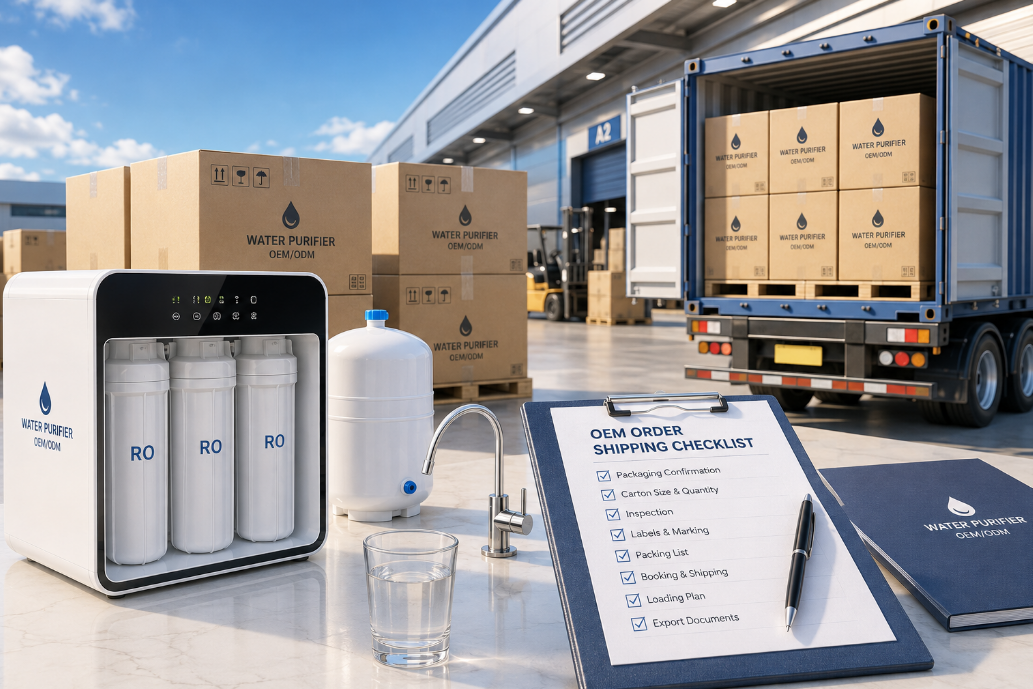
For a water purification OEM project, completing production does not mean the order is fully ready for delivery.
The period between mass-production completion and actual dispatch often determines whether the shipment stays on schedule. Packaging approval, carton data, final inspection, labels, packing documents, booking, loading and export paperwork all need to be coordinated before the goods leave the factory.
If these tasks only begin after production is finished, completed goods may still wait because packaging information, shipping data or the loading plan has not been confirmed. A more efficient OEM workflow is to prepare shipment while production is still in progress.
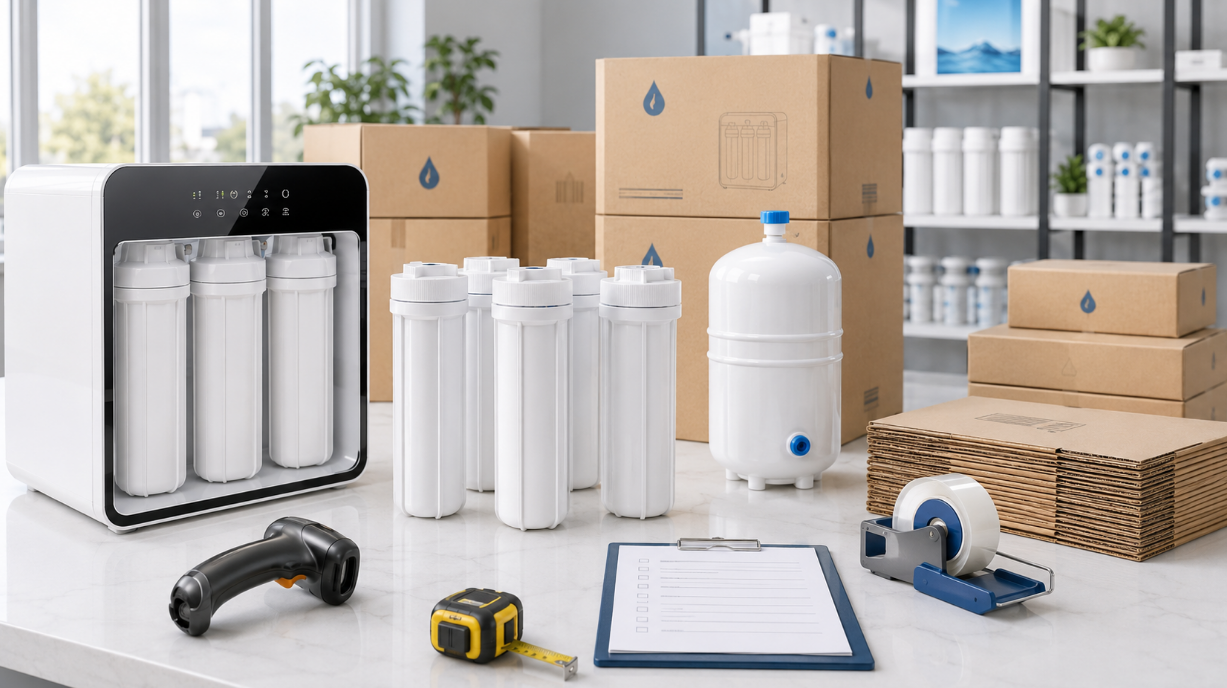
1. Start shipment preparation when the order is confirmed
Once a water purifier OEM project is confirmed, establish the basic shipment data at the same time: product models, quantities by model, individual packing method, units per carton, carton dimensions, net and gross weight, total cartons, total CBM, total gross weight, estimated completion date, destination country, destination port and required arrival time.
These figures directly affect logistics planning. If carton sizes and final quantities remain open for too long, the forwarder cannot accurately plan space, loading or the shipping schedule.
2. Approve OEM packaging before production is complete
Many OEM delivery delays are caused not by manufacturing but by packaging files that are still being revised late in the process.
Logo files, rating labels, color boxes, product labels, barcodes, manuals, filter labels, shipping marks and multilingual text should ideally be approved before mass production.
For export orders involving English, Russian, Kazakh or other languages, freeze the final artwork early. Changes after production may require reprinting, reopening cartons and repacking, which directly affects the shipping date.
3. Final carton dimensions are critical for transport planning
Water purification equipment often has relatively large packaging volume, so carton dimensions influence both freight cost and container utilization.
Confirm retail-pack dimensions, units per master carton, master-carton dimensions, gross weight, pallet requirements, pallet size, stacking limitations and maximum stacking layers as early as possible.
Before booking, recalculate the final carton quantity, total CBM and gross weight based on the approved packing specification.
4. Begin logistics planning before production is fully finished
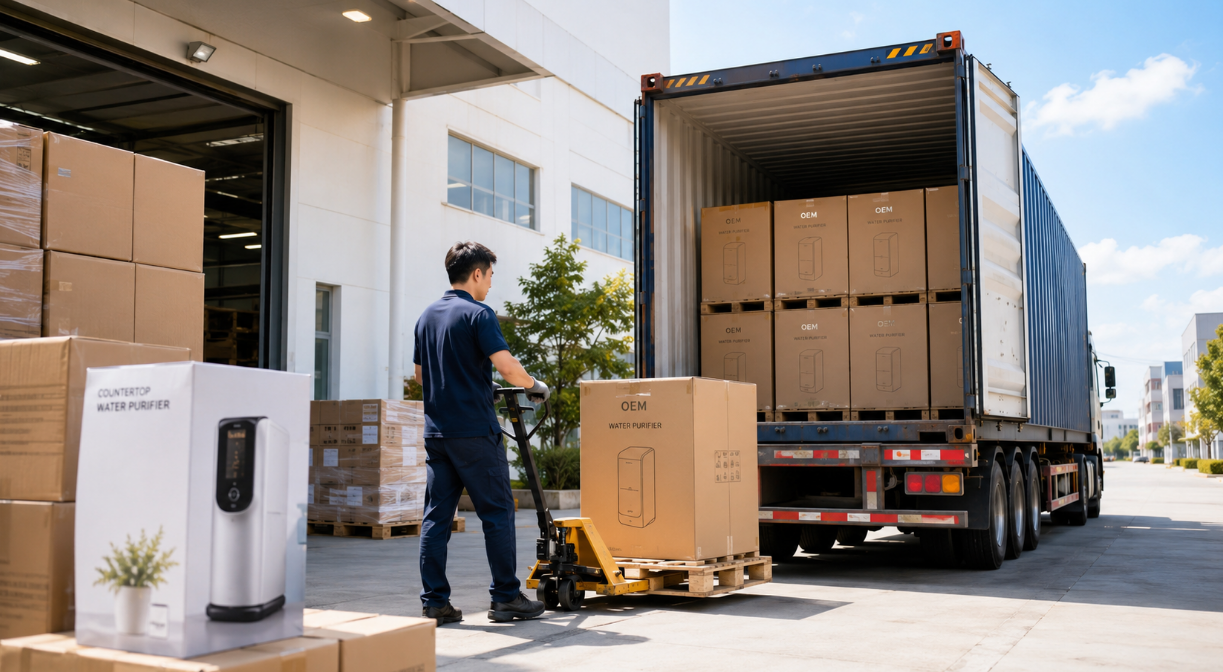
For OEM orders with a clear delivery target, do not wait until every unit has been completed before contacting the forwarder.
Once the expected Ready Date becomes reasonably clear, provide product description, carton quantity, CBM, gross weight, origin, destination port, trade terms and whether trucking or customs declaration is required.
This allows earlier confirmation of sailing schedules, available space, cut-off dates, warehouse receiving time and truck arrangements.
5. Run final inspection and shipment preparation in parallel
After production, the final check may cover model, quantity, appearance, function, accessories, power specification, labels, logo, packaging, shipping marks and carton quantity.
If third-party inspection is required, reserve the inspection window in advance. A realistic OEM schedule should include completion, inspection, possible correction, release and shipment rather than treating production completion as the loading date.
6. Mixed-model orders need a loading plan
A single OEM order may contain under-sink RO systems, countertop purifiers, hot-and-cold dispensers, ultrafiltration systems, replacement filters, faucets, fittings and other accessories.
When several models are loaded together, confirm carton quantities, carton dimensions, weight, fragility, stacking restrictions, preferred unloading sequence and whether small accessories are packed separately.
A clear loading plan improves warehouse efficiency and reduces the risk of missing cartons, incorrect loading or confusion between product groups.
7. Prepare a separate list for replacement filters and spare parts
Water purifier OEM orders often include service filters and spare parts such as PP cartridges, carbon filters, RO membranes, composite cartridges, faucets, PE tubing, fittings, power adapters, pumps and solenoid valves.
Because these items are small and numerous, prepare a separate Spare Parts List or Filter List showing model, quantity, carton number and packing method. This also makes destination receiving and after-sales inventory easier.
8. Shipping marks and Packing List must match the actual cargo
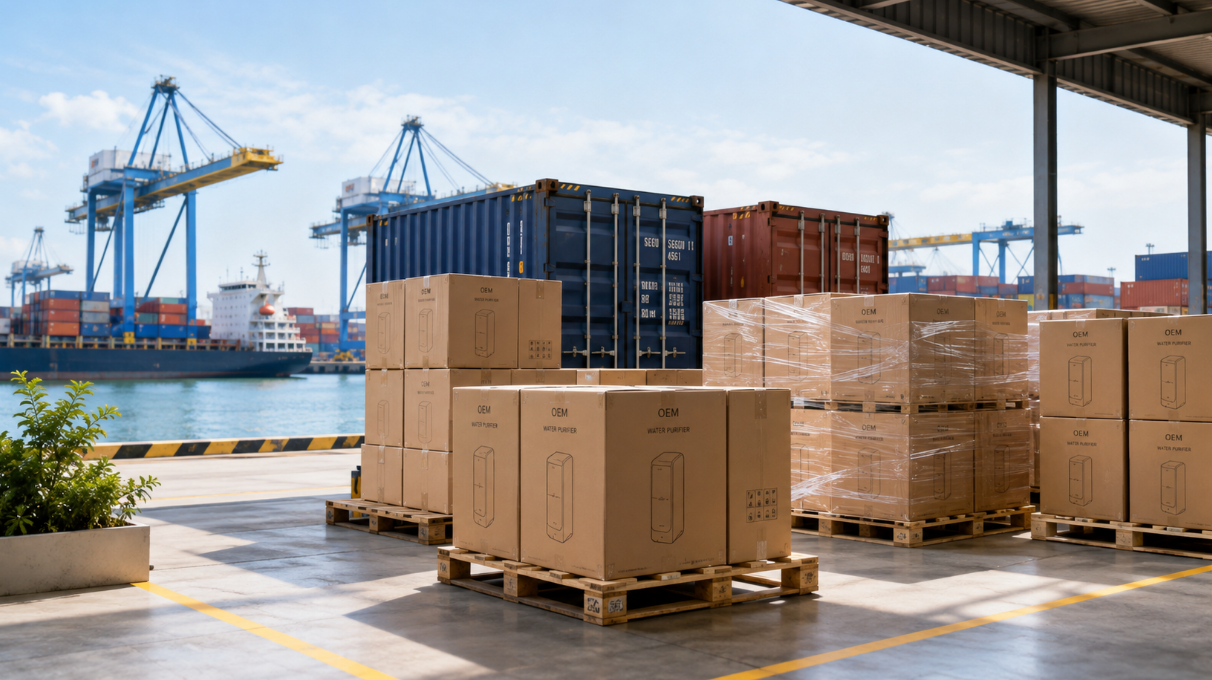
Before shipment, check product description, model, quantity, carton number, total cartons, net weight, gross weight, CBM, order reference and destination.
For mixed-model orders, sequential carton numbers such as Carton 1-20, Carton 21-45 and Carton 46-60 make warehouse handling and receiving much easier to verify.
9. Do not prepare export documents at the last minute
Export documentation should be prepared in parallel with production and logistics. Depending on the order, documents may include Commercial Invoice, Packing List, Contract, product information, customs declaration data, bill-of-lading information, origin-related documents and other destination-specific materials.
Requirements vary by country and shipment, so the customer, factory and forwarder should review the document checklist before the cargo reaches the warehouse.
10. Build a shipment timeline instead of using one delivery date
An OEM order should have several milestones: packaging approval, mass-production start, estimated completion, final inspection, cargo ready, booking confirmation, warehouse delivery or container loading, customs declaration and departure.
With these milestones, any delay can be traced to the exact stage rather than being treated as one general delivery problem.
11. Leave reasonable buffer time in both production and logistics
International shipment involves production, packing, inspection, trucking, warehouse receiving, customs clearance, terminal handling and carrier schedules. Any of these stages may change.
For projects with a required arrival date, work backward from the customer’s target arrival time and reserve time for international transport, port operations, loading, inspection and production completion.
12. Recommended pre-shipment checklist for OEM orders
- product models and quantities by model;
- total cartons, CBM and gross weight;
- final carton specifications and shipping marks;
- Packing List and Commercial Invoice;
- OEM packaging, labels and manuals;
- replacement filter and spare-parts list;
- estimated Ready Date;
- booking information and loading date;
- destination port and consignee details;
- other export documents required for the order.
Conclusion
Reliable delivery of a water purifier OEM order depends on more than manufacturing speed. Production, packaging, inspection, documents and logistics need to be connected in advance.
A well-prepared order can move into loading and international shipment more quickly once production is finished, while an order that starts logistics planning only after completion may create unnecessary waiting time.
Water Tech OEM can coordinate packaging, carton data, labels, packing documents, spare-parts lists and shipment information from the project confirmation stage so production and export logistics can connect more efficiently.